Meytal Dahan
Back to insights

Self-Identification as the First Step
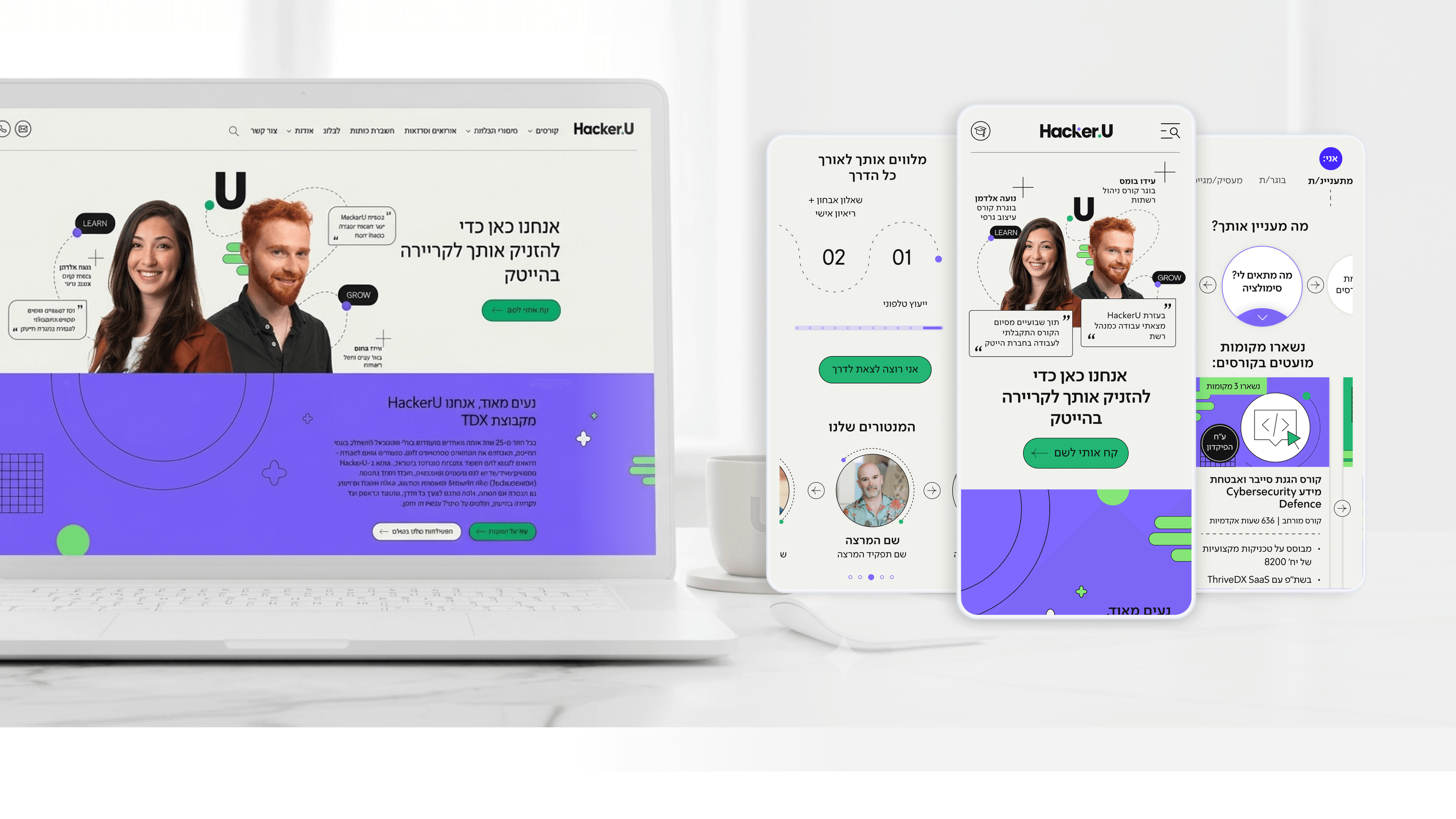
Hacker U — High tech training institute website
A marketing site has no login, no setup wizard — but it absolutely has a first run. For HackerU, that first moment is the personalized homepage entry layer, where a brand-new visitor self-identifies as a prospective student, current student, graduate, recruiter, or discharged soldier, and the primary content card adapts to them. I treated this as onboarding: the job of the first screen is to orient a stranger and route them to relevance fast. For a PM, this reframes a familiar metric. Instead of generic engagement, the question becomes whether each audience reaches content meant for them with minimal friction. So the self-identification step had to be obvious, low-effort, and reversible — a visitor should never feel locked into a wrong choice or punished for exploring. It also had to degrade gracefully: someone who skips it still lands on a coherent default rather than a dead end. The design challenge was doing all of this without a heavy gate that blocks people from the content they came for. Good first-run onboarding here isn't a tutorial; it's a single, respectful question that makes the rest of the site feel like it was built for the person who just arrived.

Get in touch

Have a project in mind?

Drop a line. Meytalyav@gmail.com

Related articles

Hacker U
Engineering LeadersR&D Collaboration

A Modular Design System R&D Could Actually Build

Designers can hand R&D a beautiful comp that's a nightmare to build. On HackerU I tried to do the opposite. The marketing site — personalized homepage, dense course pages, a placement page — runs on one modular design system designed to be implemented, not just admired. Reusable, composable components with consistent states mean engineers stop re-solving the same layout on every page. The adaptive homepage card is one pattern, not five bespoke pages. A design system earns its keep when it makes the front end cheaper to maintain, not just nicer to look at.

Read
Hacker U
Project Managers

Backlog Prioritization in an EdTech System: How Do You Run a Project That Serves Thousands of Users Simultaneously?

Project managers in EdTech: is your backlog exploding because you're trying to serve students, instructors, and marketing all at once? In the Hacker U project we built a dual-impact matrix: recruitment versus Retention. Only features that contributed to both earned priority. 3-week Sprints with clear metrics - that's your number one guardian of the Gantt chart.

Read
Hacker U
Product Managers

Learning Experience (LX): How Do You Design a Course-Management System That Students Love?

Product managers in EdTech: students aren't rational users - they're human beings on a personal journey of learning and fear of failure. In the Hacker U project we built a Learning Experience with clear progress visualization, milestones, and positive reinforcement at moments of success. UX = LX. Design the journey, not just the screens.

Read
Meytal Dahan

About

Making complicated into easy for users.

Senior product designer with a decade of work across complex systems - financial risk platforms, legal operations, healthcare apps, manufacturing tooling and insurance portals. The common thread is depth: products where the data is rich, the users are expert, and the interface has to disappear into the work.